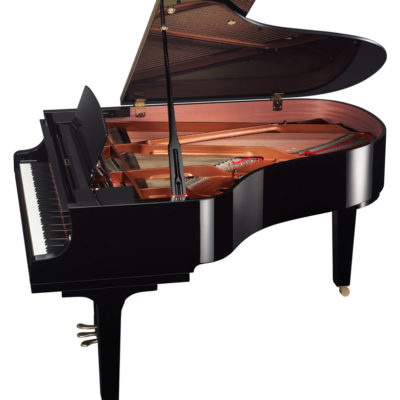

Yamaha C6X – New 7’0″
Yamaha C6X
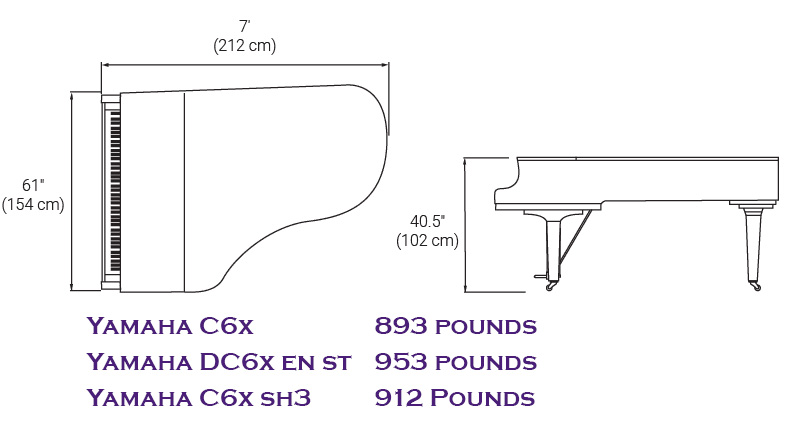
Depth 7’0″
Width 61″
Height 40.5″
Weight 893 Pounds
Made in Japan
| Yamaha C6X MSRP Prices | |
|---|---|
| C6X PE Polished Ebony | $79,499 |
| C6X SE Satin Ebony | $79,499 |
| C6X PM Polished Mahogany | $95,999 |
| C6X WH Polished White | $95,999 |
| C6X AW Polished Walnut | $95,999 |
| In Store Only | |
Also Available As


Yamaha C6X – New
The legacy of the CFX continues
Preserving tradition is not the same thing as refusing to change;rather, it is from the ongoing search for perfection that traditions emerge. And when it comes to the tradition of crafting a grand piano, there is a sound, a tone to which only those who strive constantly to outdo themselves can aspire. For almost half a century, Yamaha’s world-renowned C Series grand pianos have continued through a gradual process of refinement The CFX full concert grand piano built on the knowledge, techniques, and experience gained during this long period, with craftsmen pouring everything they knew into the creation of an instrument that took bold new steps in piano design, seeking to attain sonic perfection. The CX Series extends this work further, providing a clear sound with a clean attack, sparkling tone, and transparent harmonies, all encased in an elegant, flowing form.
The end result is a series of instruments that is refined in tone, yet bold in design, the product of a dedication to innovation that allows Yamaha to remain true to its musical heritage. CX Series pianos represent progress that is commensurate with Yamaha’s 125th anniversary year – progress that will transform any room in which you play into a concert hall.

Strings
It is music wire that actually creates sound of a piano. While affected by its matching with the hammers, soundboard and body of the piano, music wire has a profound effect on the timbre and sustain of the instrument. The CX Series utilizes music wire that produces a rich sound with a full complexity of overtones in its middle and upper registers. Coupled with the support from a solid foundation, this gives CX Series pianos a rich, harmonic sound.

Yamaha C6x Hammers
Great hammers are essential to producing a beautifully expressive, malleable sound. Yamaha, unlike most other piano manufacturers, produces most of its own high-quality components, and is constantly looking for new ways to use the abilities developed through doing so to give our piano hammers tonality, resilience, and power. The CX Series has also benefitted from the results of this research and development, and utilizes the same felt as the CFX, adjusted to match the size of each instrument in the series. This ensures that all CX Series pianos possess a clear range of tonal colors and a nuanced, expressive sound.

Voicing and regulation
Pianos offer pianists only a limited amount of freedom; indeed, apart from the pedals, the pianist’s scope for expression is limited to the 10 mm travel of each of the 88 keys on the keyboard. Even so, the combination of the pedals with the speed and velocity applied to the keys produces a range of tonal changes so broad that they cannot be reproduced with current digital technology. This is the true soul of an acoustic instrument, allowing the pianist to obtain an incredible amount of expression from just 10 mm of key travel.That is precisely why Yamaha devotes so much time voicing their pianos so that the intentions of the pianist are conveyed to the strings. In regulation, a craftsman adjusts the movement of the action so that it accurately transmits every nuance of the pianist’s touch. In voicing, the hammers, which cause the strings to emit sound, are pricked with a pick to create a balanced tone that will respond beautifully when played. Even today, in an era when technology continues to evolve rapidly, these tasks remain the domain of skilled craftsmen who must ensure the high quality of these instruments, and are the main reason that Yamaha has remained one of the top piano makers in the world.

A design that unifies piano with pianist
CX Series pianos feature a completely revamped design. Following in the footsteps of the CF Series concert grand, the CX Series design features simple, elegant lines, focusing on the characteristic legs of the piano in doing away with any excess ornamentation. This elegance is set off by a solid pedal box that allows performers to depress the pedals with as much power as they want, one aspect of a philosophy epitomizing “functional design” that allows pianists to become one with their instrument as they play. In order to provide the best playability possible, CX Series grand pianos offer white keys made of Ivorite™, which has a feel, color, and absorbency very similar to natural ivory, while natural ebony has been used for the black keys.

peace of mind
– The CX Series is equipped with a lid prop stopper to prevent your fingers from being caught when the piano lid closes unexpectedly. – The fallboard is fitted with a soft landing mechanism that means you no longer have to worry about the fallboard shutting on your fingers unexpectedly
Yamaha C6x Soundboard
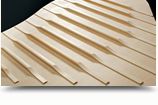
A violin is built around a beautiful body with three-dimensional swellings and a delicately curved shape, which is similar to the three dimensional concave design in a piano soundboard called the “crown.” The manufacture of this crown is pivotal to the crafting of any piano, and is thus of paramount importance to piano engineers in addressing the problem of how to transmit the vibrations of the strings from the soundboard into the surrounding air efficiently. Yamaha has taken experience accumulated through many years of crafting pianos and combined it with unsurpassed engineering ability to ensure that the soundboard always provides superb projection. The resulting design capitalizes on physical phenomena unique to the craft of piano-making, to create a soundboard assembly with a structure that allows it to vibrate easily, something that would not have been possible without the deep understanding of the traditional art of piano crafting that goes hand-in-hand with Yamaha’s experience and engineering know-how. The same techniques developed for gluing the soundboard, ribs, and bridge in the CFX are used for the C3X and above—models which require a great deal of projection—and the process of installing the resulting soundboard assembly into the piano body has been investigated carefully. This has resulted in dramatically improved projection and the unprecedented response that performers demand.

Back Posts
One of the most important factors in achieving a rich tone is the support provided within the instrument. When playing powerful fortissimo the force exerted on the instrument causes it to bend slightly, losing energy. The part of the piano that accepts this force and transforms it into deep reverberation is called the back frame, which could be likened to the skeleton in a human body. On the C3X for example, this back frame is approximately 20% thicker than on other pianos, providing significantly improved support, and reflecting the considerations on which the CX Series has been completely redesigned.
Yamaha C6X Piano Video
Get in Touch
Have questions? Our piano specialists are here to help. Call (732) 462-4730 or send us a message.